


When preparing for retirement, most traditional financial planning focuses on a single summary metric: your average annual rate of return. We are often taught to calculate our nest egg’s future value using an assumed long-term average—say, 6% or 8% per year—and assume that as long as the math works on paper, our financial security is assured.
However, as a senior financial advisor, I frequently remind clients that the order in which those returns occur matters just as much as—and often more than—the average return itself. This phenomenon is known as Sequence of Returns Risk (or sequence risk). It is one of the most critical, yet frequently overlooked, hazards facing individuals as they transition from the accumulation phase of wealth building to the decumulation phase in retirement.
What Is Sequence of Returns Risk?
Sequence of returns risk refers to the risk that the timing of market downturns will negatively impact the overall longevity of a portfolio. While market volatility is a natural part of investing, its impact changes dramatically once you begin taking systematic withdrawals.
During your working years, market downturns can actually work in your favor through dollar-cost averaging, allowing you to purchase more shares at lower prices. But once you retire and reverse the process—selling assets to fund living expenses—a market decline in the early years can permanently impair your portfolio's ability to recover.
A Tale of Two Retirees
To illustrate how sequence risk operates in practice, consider two hypothetical retirees, Alice and Bob. Both start with a $1,000,000 portfolio and withdraw $50,000 (5% of the initial portfolio value) at the beginning of each year. Over a 3-year period, both portfolios experience the exact same three annual returns: -20%, 0%, and +20%. The only difference is the sequence in which these returns occur.
Alice (Unfavorable Sequence):
Start: $1,000,000
Year 1: Withdraws $50,000 $\rightarrow$ $950,000 remaining. Market drops -20%. Ending balance: $760,000.
Year 2: Withdraws $50,000 $\rightarrow$ $710,000 remaining. Market returns 0%. Ending balance: $710,000.
Year 3: Withdraws $50,000 $\rightarrow$ $660,000 remaining. Market gains +20%. Ending balance: $792,000.
Bob (Favorable Sequence):
Start: $1,000,000
Year 1: Withdraws $50,000 $\rightarrow$ $950,000 remaining. Market gains +20%. Ending balance: $1,140,000.
Year 2: Withdraws $50,000 $\rightarrow$ $1,090,000 remaining. Market returns 0%. Ending balance: $1,090,000.
Year 3: Withdraws $50,000 $\rightarrow$ $1,040,000 remaining. Market drops -20%. Ending balance: $832,000.
Despite experiencing the exact same average market returns and identical withdrawal amounts, Alice ends Year 3 with $792,000, while Bob ends with $832,000—a $40,000 difference in just three years.
When a portfolio sustains heavy losses early in retirement, selling depreciated assets to fund income locks in those losses. Consequently, there are fewer remaining shares left in the portfolio to participate when the market eventually rebounds. This creates a compounding deficit known as portfolio burnout (Kitces).
The "Fragile Zone" of Retirement
Financial planners often refer to the period spanning the 5 to 10 years immediately preceding retirement and the 5 to 10 years immediately following retirement as the "Fragile Zone" or the "Retirement Risk Zone" (Blanchett et al. 12).
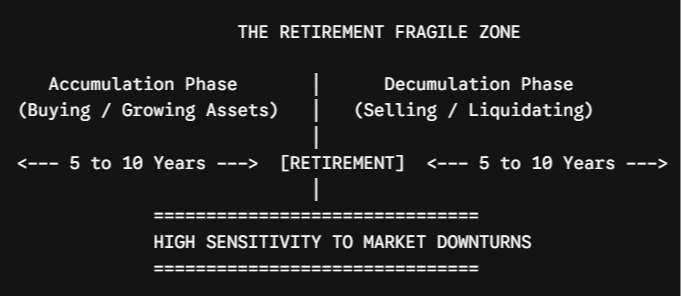
During this window, your nest egg is typically at its peak value, and you have limited time or human capital to replenish losses through earned income. A severe market contraction during this critical threshold can significantly elevate the risk of prematurely exhausting your funds.
How to Mitigate Sequence of Returns Risk
While no advisor can predict or control short-term market fluctuations, a well-structured wealth management strategy can effectively insulate your retirement plan against a poorly timed market dip.
1. The Cash Buffer / Bucket Strategy
One of the most effective ways to combat sequence risk is to structure your assets into distinct "time-horizon buckets" (Pfleau 45).
Bucket 1 (Immediate Cash/Liquidity): Keep 1 to 3 years worth of net living expenses in liquid, low-volatility vehicles such as money market accounts, short-term treasury bills, or high-yield savings accounts.
Bucket 2 (Intermediate Income): Allocate 3 to 7 years of income needs into short-to-intermediate-term fixed income instruments.
Bucket 3 (Long-Term Growth): Maintain equities and growth assets meant to compound over 8+ years.
If a severe market downturn hits in years 1 or 2 of retirement, you do not need to liquidate equity holdings at a loss. Instead, you draw living income directly from your cash buffer, giving your growth investments time to recover.
2. Flexible Withdrawal Strategies
The classic "4% Rule" assumes a fixed withdrawal amount adjusted upward for inflation every year, regardless of market performance (Bengen 31). However, adopting dynamic withdrawal rules provides significantly greater safety.
Guardrails Strategy: Establish pre-determined boundaries for your withdrawal rates. If market declines push your withdrawal rate above a upper guardrail (e.g., 5.5%), you temporarily reduce discretionary spending. Conversely, if market gains lower your withdrawal rate below a lower threshold, you can safely increase distributions (Guyton and Klinger 52).
3. Dynamic Asset Allocation in Pre-Retirement
To reduce vulnerability heading into retirement, some researchers suggest utilizing a bond ladder or a temporary rising equity glidepath (Kitces and Pfau 18). Rather than increasing bond allocations as you age indefinitely, a rising equity glidepath involves starting retirement with a lower equity exposure (e.g., 30–40%) to mitigate drawdown risk in the early years, then gradually re-increasing equity exposure over time as the sequence risk window passes.
4. Maximizing Guaranteed Lifetime Income
Increasing the proportion of your essential expenses covered by guaranteed, non-market-correlated income sources reduces the strain on your investment portfolio during market drops. Maximizing Social Security benefits—such as delaying claims until age 70 to capture 8% annual delayed retirement credits—or utilizing fixed lifetime annuities can establish a durable income floor (Blanchett et al. 24).
Final Thoughts
The timing of your retirement is often driven by career milestones, personal goals, or health considerations rather than optimal market conditions. While you cannot choose whether your retirement date coincides with a bull or bear market, understanding Sequence of Returns Risk allows you to design a resilient distribution framework.
By combining cash buffers, flexible spending rules, and strategic asset allocation, you can protect your portfolio against early market headwinds and preserve your financial independence for decades to come.
Works Cited
Bengen, William P. "Determining Withdrawal Rates Using Historical Data." Journal of Financial Planning, vol. 7, no. 4, 1994, pp. 171–180.
Blanchett, David, Michael Finke, and Wade D. Pfau. "Asset Allocation and the Transition to Retirement." Journal of Retirement, vol. 1, no. 3, 2014, pp. 11–26.
Guyton, Jonathan T., and William J. Klinger. "Decision Rules and Portfolio Management for Retirees: Making 'Safe Initial Withdrawal Rates' Safer." Journal of Financial Planning, vol. 19, no. 10, 2006, pp. 50–58.
Kitces, Michael. "Understanding Sequence of Returns Risk: Safe Withdrawal Rates, Bear Markets, and Bad Timing." Nerd's Eye View, Kitces.com, 2014.
Kitces, Michael, and Wade D. Pfau. "Reducing Retirement Risk with a Rising Equity Glidepath." Journal of Financial Planning, vol. 27, no. 9, 2014, pp. 17–25.
Pfau, Wade D. Safety-First Retirement Planning: An Integrated Approach for a Worry-Free Retirement. Retirement Researcher Media, 2019.